O que fazer em Banjarsari

Surakarta

At the museum no photos are allowed which is really unfortunate as it was well worth the visit and the guided tour is definitely not to be missed. In the museum there are even Batik made from the Dutch era which depicts stories like Little Red Riding Hood and Snow White!

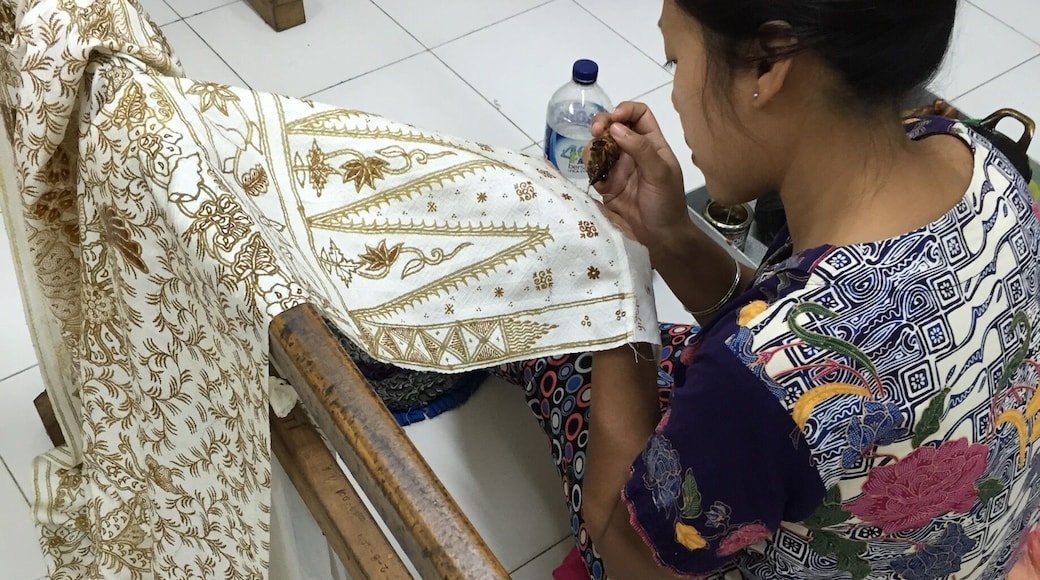
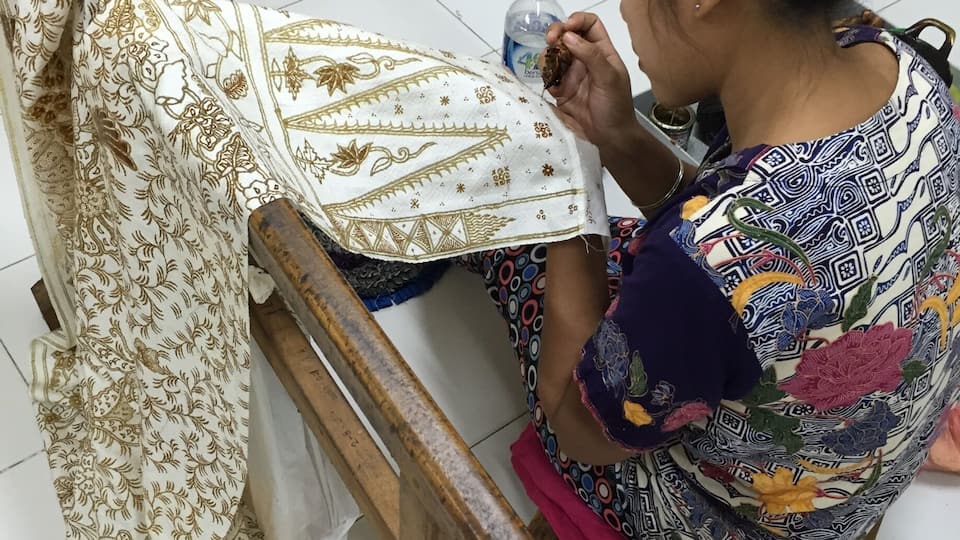
I enjoyed the tour v much and at the end of the tour we were brought to this room where the artisan were working on hand drawn batik.

Below is an excerpt from Wikipedia for anyone interested in learning more about the process of batik making.

Firstly, a cloth is washed, soaked and beaten with a large mallet. Patterns are drawn with pencil and later redrawn using hot wax, usually made from a mixture of paraffin or bees wax, sometimes mixed with plant resins, which functions as a dye-resist. The wax can be applied with a variety of tools. A pen-like instrument called a canting (IPA: [tʃantiŋ], sometimes spelled with old Dutch orthography tjanting) is the most common. A canting is made from a small copper reservoir with a spout on a wooden handle. The reservoir holds the resist which flows through the spout, creating dots and lines as it moves. For larger patterns, a stiff brush may be used. Alternatively, a copper block stamp called a cap (IPA: [tʃap]; old spelling tjap) is used to cover large areas more efficiently.

After the cloth is dry, the resist is removed by scraping or boiling the cloth. The areas treated with resist keep their original color; when the resist is removed the contrast between the dyed and undyed areas forms the pattern. This process is repeated as many times as the number of colors desired.

The most traditional type of batik, called batik tulis (written batik), is drawn using only the canting. The cloth need to be drawn on both sides and dipped in a dye bath three to four times. The whole process may take up to a year; it yields considerably finer patterns than stamped batik.

Source: Wikipedia
At the museum no photos are allowed which is really unfortunate as it was well worth the visit and the guided tour is definitely not to be missed. In the museum there are even Batik made from the Dutch era which depicts stories like Little Red Riding Hood and Snow White!

I enjoyed the tour v much and at the end of the tour we were brought to this room where the artisan were working on hand drawn batik.

Below is an excerpt from Wikipedia for anyone interested in learning more about the process of batik making.

Firstly, a cloth is washed, soaked and beaten with a large mallet. Patterns are drawn with pencil and later redrawn using hot wax, usually made from a mixture of paraffin or bees wax, sometimes mixed with plant resins, which functions as a dye-resist. The wax can be applied with a variety of tools. A pen-like instrument called a canting (IPA: [tʃantiŋ], sometimes spelled with old Dutch orthography tjanting) is the most common. A canting is made from a small copper reservoir with a spout on a wooden handle. The reservoir holds the resist which flows through the spout, creating dots and lines as it moves. For larger patterns, a stiff brush may be used. Alternatively, a copper block stamp called a cap (IPA: [tʃap]; old spelling tjap) is used to cover large areas more efficiently.

After the cloth is dry, the resist is removed by scraping or boiling the cloth. The areas treated with resist keep their original color; when the resist is removed the contrast between the dyed and undyed areas forms the pattern. This process is repeated as many times as the number of colors desired.

The most traditional type of batik, called batik tulis (written batik), is drawn using only the canting. The cloth need to be drawn on both sides and dipped in a dye bath three to four times. The whole process may take up to a year; it yields considerably finer patterns than stamped batik.

Source: Wikipedia

Atrações populares


Banjarsari: os melhores hotéis

Novotel Solo

Novotel Solo

4 out of 5
Jalan Slamet Riyadi 272 Surakarta Central Java
Totalmente reembolsávelReserve agora, pague durante a estadia
O preço é de R$ 152 por diária para uma estadia de 19 de fev. a 20 de fev..
R$ 152
Total: R$ 184
19 de fev. – 20 de fev.
inclui impostos e taxas
Hospede-se neste hotel com spa em Surakarta. Desfrute de Wi-Fi grátis, estacionamento grátis e 2 piscinas externas. Atrações populares como Danar Hadi e Museu ...
8/10 Very Good! (113 avaliações)
房間乾淨,服務也很到位,有提供飲用水,但是浴室有很多發霉的地方,抽風機會發出巨大的噪音,可能要更換比較好

Avaliada em 4 de set. de 2025

Novotel Solo
Moxy Solo

Moxy Solo

3.5 out of 5
Jl. Slamet Riyadi No.173, Kemlayan Surakarta Central Java
O preço é de R$ 186 por diária para uma estadia de 17 de fev. a 18 de fev..
R$ 186
Total: R$ 225
17 de fev. – 18 de fev.
inclui impostos e taxas
Reserve uma estadia neste hotel em Surakarta. Desfrute de Wi-Fi grátis, estacionamento grátis e café da manhã (sobretaxa). Atrações populares como Museu Radya ...
9,2/10 Wonderful! (7 avaliações)
It was a chic and clean hotel in the center of the city. The staff was very friendly.

Avaliada em 28 de dez. de 2024

Moxy Solo
Swiss-Belhotel Solo

Swiss-Belhotel Solo

4 out of 5
Jalan Ahmad Yani 45 Surakarta Jawa Tengah
O preço é de R$ 219 por diária para uma estadia de 2 de mar. a 3 de mar..
R$ 219
Total: R$ 265
2 de mar. – 3 de mar.
inclui impostos e taxas
Hospede-se neste hotel com spa em Surakarta. Desfrute de Wi-Fi grátis, estacionamento grátis e um spa de serviço completo. Atrações populares como Clínica Nakamura ...
9,2/10 Wonderful! (38 avaliações)
Quarto com bela vista e confortável.

Avaliada em 29 de ago. de 2025

Swiss-Belhotel Solo
ibis Styles Solo

ibis Styles Solo

3 out of 5
Jalan Gajah Mada 23 Surakarta Central Java
O preço é de R$ 113 por diária para uma estadia de 3 de mar. a 4 de mar..
R$ 113
Total: R$ 137
3 de mar. – 4 de mar.
inclui impostos e taxas
Hospede-se neste hotel com spa em Surakarta. Desfrute de Wi-Fi grátis, estacionamento grátis e 2 piscinas externas. Atrações populares como Museu Radya Pustaka ...
8/10 Very Good! (103 avaliações)
Perfect place for transit.......... Pool is delightful Bubur Ayam for breakfast 😍

Avaliada em 17 de jan. de 2026

ibis Styles Solo
Red Chilies Hotel

Red Chilies Hotel

3.5 out of 5
jl aA Yani 286 gondang Surakarta Central Hotel
Hospede-se neste hotel ideal para negócios em Surakarta. Desfrute de Wi-Fi grátis, estacionamento grátis e café da manhã (sobretaxa). Atrações populares como ...
Red Chilies Hotel
FIM by Zigna

FIM by Zigna

3 out of 5
31 Jl. Yosodipuro Surakarta Jawa Tengah
Hospede-se neste hotel com spa em Surakarta. Desfrute de Wi-Fi grátis, estacionamento grátis e um spa de serviço completo. Atrações populares como Clínica Nakamura ...
9,4/10 Exceptional! (6 avaliações)
The hotel is an excellent place to stay. The hotel itself is not special or fancy, but it is well-run, clean, and located in the center of Solo. The breakfast buffet is excellent, the restaurant is good, and the hotel also has a nice cafe with an outside seating area. They featured life music at ...

Avaliada em 19 de jul. de 2025

FIM by Zigna
Preço mais baixo por noite encontrado nas últimas 24 horas, com base em uma estadia de 1 diária para 2 adultos. Os preços e a disponibilidade estão sujeitos a alterações. Termos adicionais se aplicam.

Outros bairros perto de Banjarsari

At the museum no photos are allowed which is really unfortunate as it was well worth the visit and the guided tour is definitely not to be missed. In the museum there are even Batik made from the Dutch era which depicts stories like Little Red Riding Hood and Snow White!

I enjoyed the tour v much and at the end of the tour we were brought to this room where the artisan were working on hand drawn batik.

Below is an excerpt from Wikipedia for anyone interested in learning more about the process of batik making.

Firstly, a cloth is washed, soaked and beaten with a large mallet. Patterns are drawn with pencil and later redrawn using hot wax, usually made from a mixture of paraffin or bees wax, sometimes mixed with plant resins, which functions as a dye-resist. The wax can be applied with a variety of tools. A pen-like instrument called a canting (IPA: [tʃantiŋ], sometimes spelled with old Dutch orthography tjanting) is the most common. A canting is made from a small copper reservoir with a spout on a wooden handle. The reservoir holds the resist which flows through the spout, creating dots and lines as it moves. For larger patterns, a stiff brush may be used. Alternatively, a copper block stamp called a cap (IPA: [tʃap]; old spelling tjap) is used to cover large areas more efficiently.

After the cloth is dry, the resist is removed by scraping or boiling the cloth. The areas treated with resist keep their original color; when the resist is removed the contrast between the dyed and undyed areas forms the pattern. This process is repeated as many times as the number of colors desired.

The most traditional type of batik, called batik tulis

Centro da Cidade de Solo

Há muito o que se ver em Centro da Cidade de Solo, como os museus e o zoológico. Solo Paragon Lifestyle Mall e Parque Keprabon são algumas atrações que você não pode deixar de conhecer.

Centro da Cidade de Solo


O que fazer em Banjarsari

Escolha dois ou mais produtos e economize na sua viagem: